
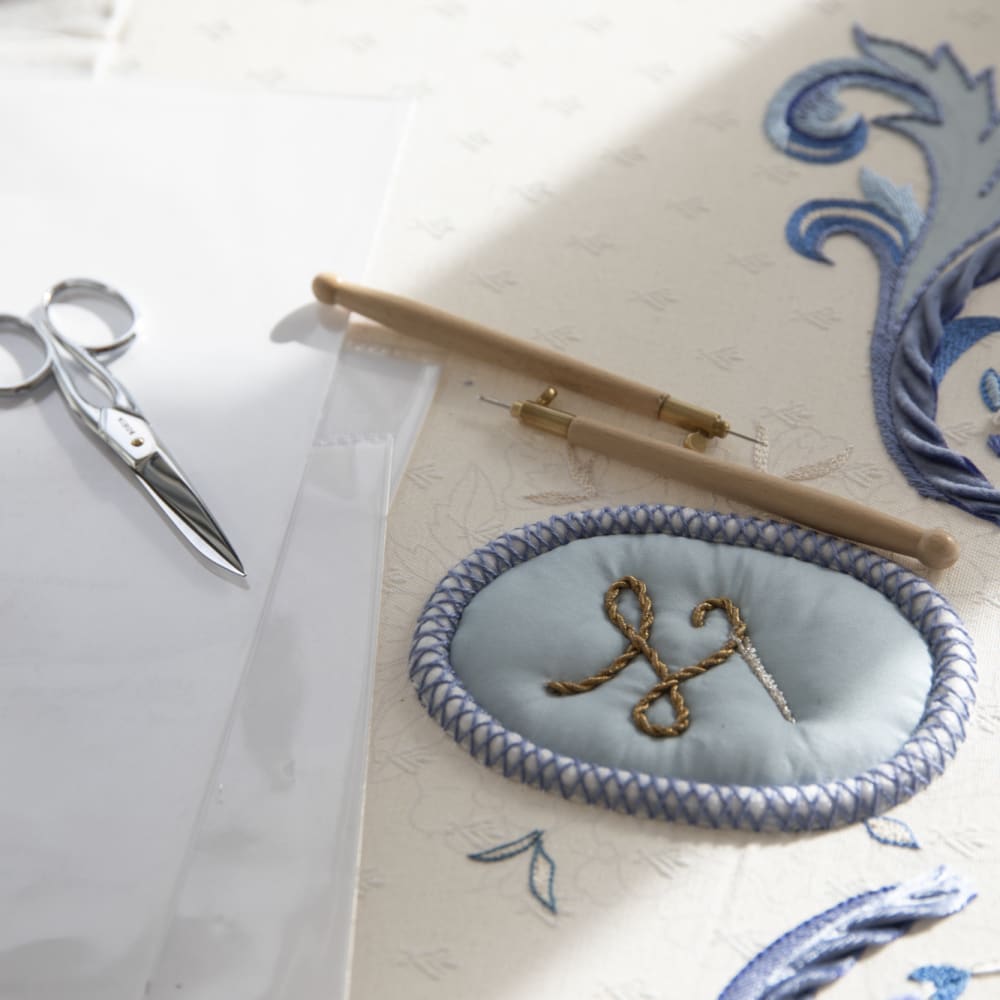
Ecole Lesage provides a wide range of training courses for both beginner and experienced embroiderers; for passionate enthusiasts and professionals seeking out training recognised by leading luxury and fashion houses.
Whether it be for Haute Couture or Ready-to-Wear, the Métiers d'Art bring together an impressive number of complementary and extremely demanding specialties.
Ecole Lesage provides a wide range of training courses for both beginner and experienced embroiderers; for passionate enthusiasts and professionals seeking out training recognised by leading luxury and fashion houses.



Atelier Montex’s originality lies in its ability to subvert embroidery codes, introducing unexpected materials such as paper, wood, or concrete. With the Lunéville hook, needle, or Cornely machine, artisans embroider beads, sequins, and materials imagined by the workshop in a gesture handed down since 1949. Every pattern is born from ever-renewed creativity.

Since 1929, Desrues crafts jewellery, buttons and accessories for the most famous fashion houses. These aesthetic and technical creations require exceptional expertise and countless hours of work. As Gabrielle Chanel’s official jewellery maker, Desrues became the first Maison to join what would later become CHANEL’s Métiers d’art ecosystem in 1985.

Specialising in the design and manufacture of lingerie, swimwear and activewear, ERES combines traditional corsetry expertise with the latest contemporary techniques. In the workshop, pattern makers, cutters and seamstresses work alongside the designers who create the collections.

Goossens distinguishes its art through goldsmithing that spans scales, from jewelry to decoration. Bronze and brass are lost-wax cast, chiseled, hammered, polished, gilded, and patinated to the perfect shade. Every gesture, passed from artisan to artisan since 1950, gives the metal an allure both ancient and contemporary, making each piece a unique ornament.

At Lemarié, uniqueness lies in the combination of five exceptional crafts: featherwork, floral adornment, pleating, couture, and textile embellishment. Each discipline has its own language, yet all converse to invent unprecedented creations. From feathers shaped with a retroussette to flowers crafted petal by petal, every gesture is rooted in ever-evolving and perfected precision. Inheriting a heritage of centuries-old tools passed down since 1880, the Maison tirelessly perpetuates and renews the art of detail.

With a unique heritage of over 75,000 samples, Lesage has been an essential House of French art embroidery since 1924. Using needle or Lunéville hook, the embroiderers transform thread, beads, and sequins into shimmering light, following patiently crafted designs. Stitch by stitch, each motif comes alive under expert hands. Lesage’s expertise is also embodied in the creation of handwoven tweeds. On the loom the fabric takes shape like a musical score under the artisans’ hands, a tradition continued since 1996.

Lesage has been designing and handcrafting embroideries for decoration, ranging from classical to contemporary styles. For museums, heritage sites, and exceptional projects, Lesage Intérieurs creates unique embroidered pieces, sometimes in extraordinary dimensions. The result of a meeting between French and Indian expertise, Lesage Intérieurs relies on the excellence of the Vastrakala workshop, located in Chennai, India.

Distinguished by its heritage of more than 3,000 cardboard moulds, Atelier Lognon elevates pleating to an art form in its own right. This refined work, entirely handmade, sculpts fabric into infinite reliefs: accordion, sunray, fan, flower… Slipped into the “métiers,” the fabric takes shape before being set with steam. Every fold, born of a precise gesture passed down since 1853, carries the memory of a living tradition for which no school exists.

At Maison Michel, the specialty is uniting all the gestures of millinery within a single workshop. From the limewood block carved by the block-maker to the felt molded with steam, from assembling the trimmings to the final touch by the milliner, each stage is mastered with a precision inherited since 1936. Thus, every hat flourishes under one roof, in a continuous flow of gestures and excellence.

As the only bespoke shoemaking workshop for women, Massaro cultivates the art of the unique shoe. Everything begins with a wooden last, sculpted with a gouge to match each client’s arch. The leather, chosen and cut along the grain, is then shaped and stretched by hand. From measurement to delivery, every shoe is born from patient, meticulous savoir-faire, handed down since 1894.

Paloma’s uniqueness lies in the art of taming the most delicate materials, from veil to mousseline. Worked by hand, “flou” demands subtle rigor: silk, organza, gauze, and crêpe are embroidered, smocked, or openworked on machines that are sometimes over a century old. Each perfectly tailored dress or skirt reflects a precise, ever-renewed gesture since 1982.

Studio MTX’s uniqueness lies in the art of translating embroidery into the heart of interior architecture. Founded in 2013 within Atelier Montex, Studio MTX designs bespoke creations that structure and animate spaces, making embroidery a language of architecture in its own right. At the service of the most demanding projects, the studio liberates embroidery from its traditional support to serve the space itself.
